

If you’re renovating a small bathroom, the vanity decision matters more than almost anything else in the room. It’s the biggest single piece of furniture in a space that’s already tight, and unlike tapware or a mirror, it’s not something you can swap out easily once it’s plumbed in and tiled around. So it’s worth stopping on this one before you order anything.
The choice usually comes down to two formats: wall-hung, where the cabinet is mounted to the wall and the floor underneath is left clear, or freestanding, where it sits on the floor like a piece of furniture. Both do the same basic job. But in a small bathroom, they behave quite differently, and picking the wrong one is a hard thing to undo.
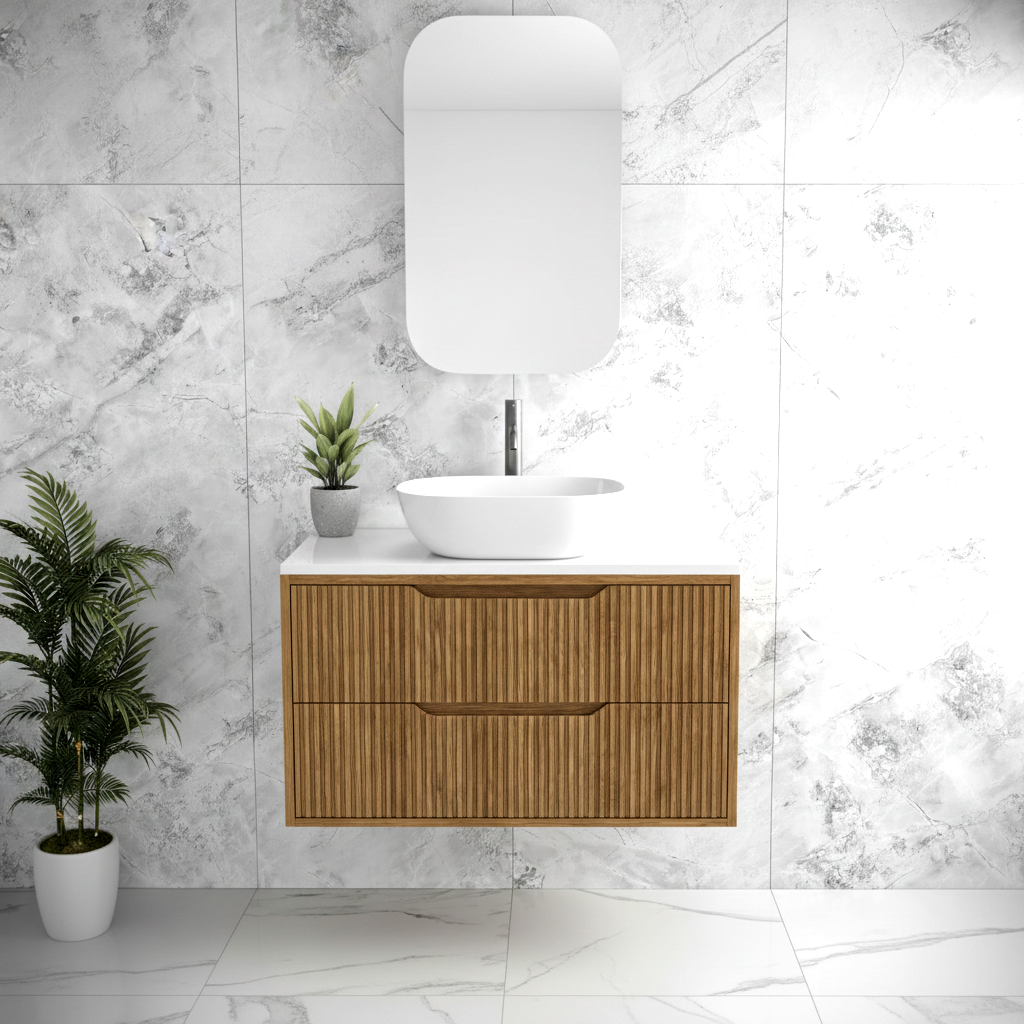
The Case for Wall-Hung
A wall-hung vanity is bolted to the wall on a concealed bracket, with the floor left open underneath. That gap is the entire point. In a small bathroom, floor space reads as room size — your eye follows the floor line all the way to the skirting, and a break in that line (a vanity sitting on legs, or worse, boxed to the floor) makes the room look shorter than it is. Leave that strip of floor visible and the same room feels noticeably bigger, even though you haven’t moved a wall.
It’s not just visual. That gap makes cleaning genuinely easier — no gap between cabinet and floor for hair, dust and grime to build up in, no grout line hidden behind a kickboard. If you’ve ever tried to mop under a floor-standing vanity with an angle grinder’s worth of clearance, you’ll know why tradies like specifying wall-hung in wet, high-traffic bathrooms.
The trade-off is installation. A wall-hung vanity needs a solid fixing point — stud, noggin, or a plywood backing board behind the sheeting — because the whole weight of the cabinet, the top, and everything you put in the drawers is hanging off that one wall. If your wall is standard plasterboard with nothing behind it, you’re either adding blocking before you sheet, or you’re not doing wall-hung. This is a decision to make at the framing stage, not after the tiler’s finished, so if you’re set on wall-hung, tell your builder early.
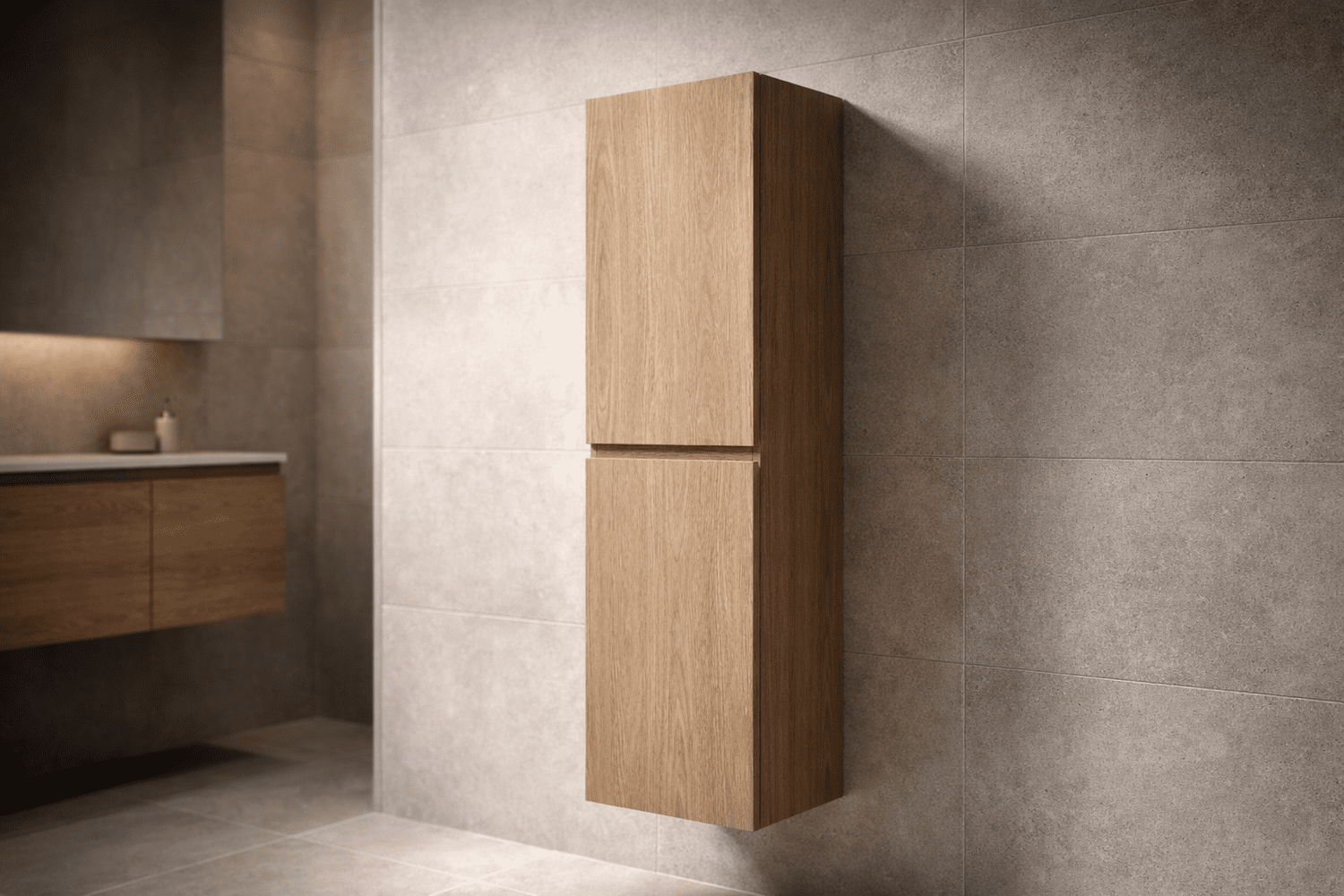
Something like the Nimis 900 Wall Hung Vanity with Matte White Solid Surface Top is a good example of the format done well for a small-to-mid bathroom — 900mm wide, solid surface top (so no grout lines to keep clean on top either), soft-close drawers, and it reads light against the wall because there’s nothing visually anchoring it to the floor. For a narrower room, the Tarnos 900mm Wall Hung Vanity and Solid Surface Top does a similar job in a slightly different cabinet style, and if you need vertical storage rather than width — say a powder room where floor space is genuinely scarce — the Tarnos Wall Hung Tall Boy in Oak gives you a tower of storage without eating into the footprint at all.
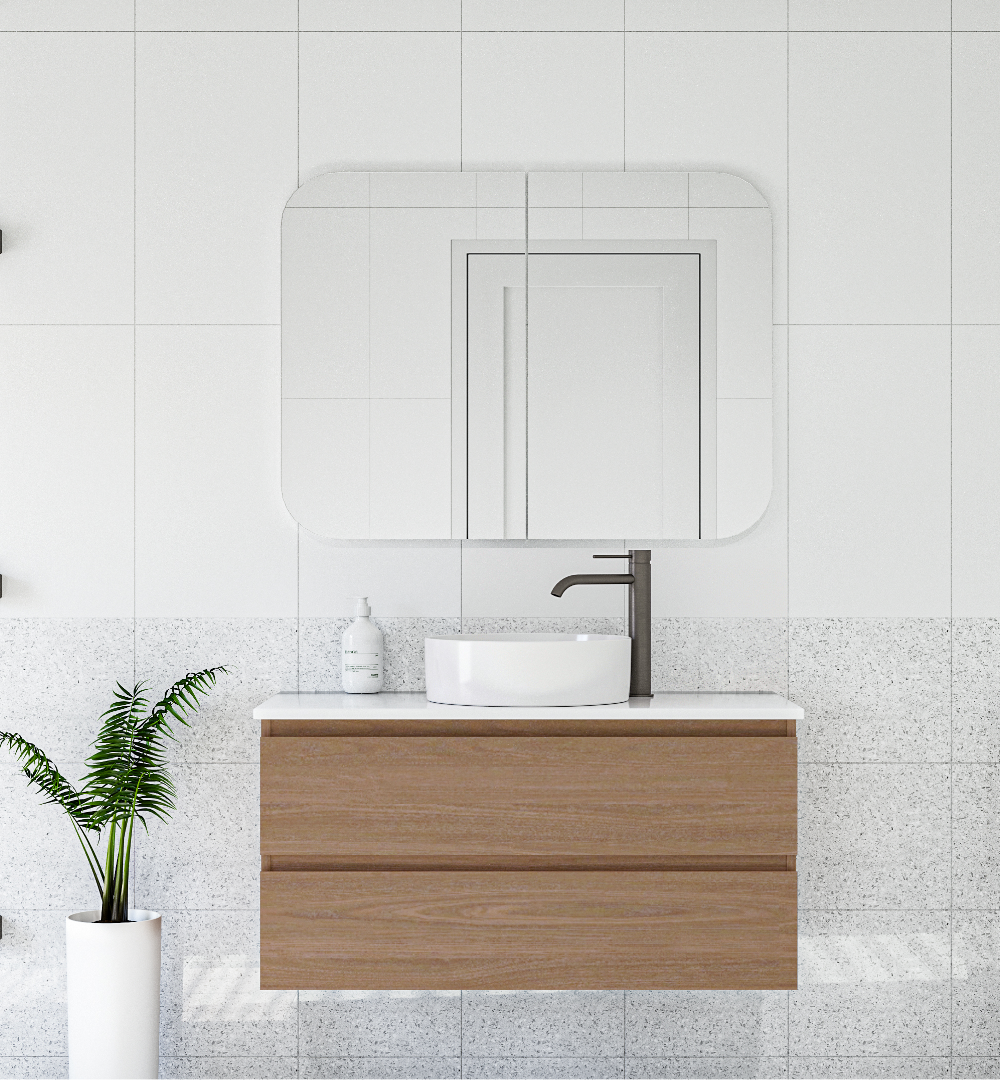
The Case for Freestanding
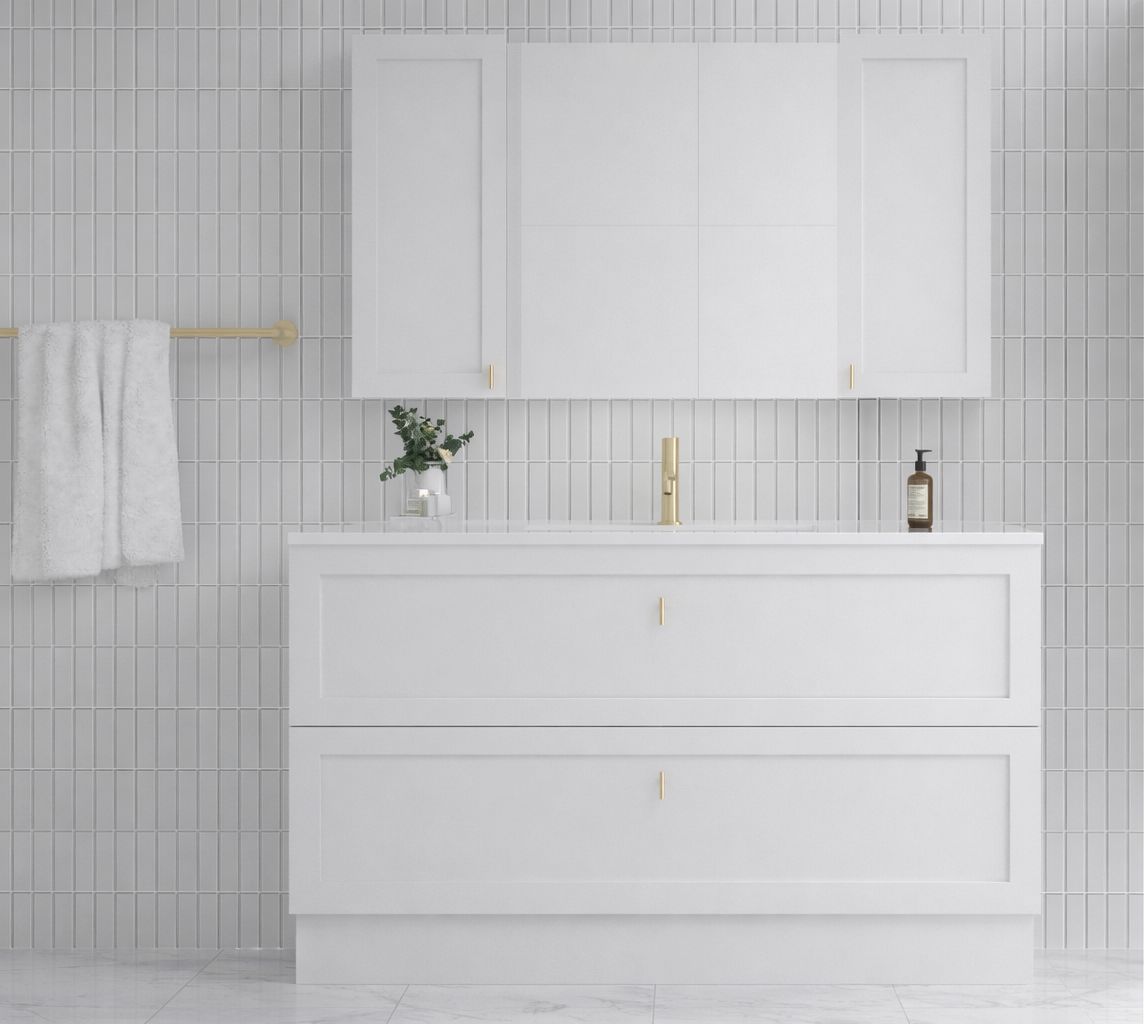
Freestanding vanities sit on the floor, either on a kickboard or on legs, the same way a piece of furniture would. The main appeal is storage. Because the whole cabinet carries its own weight down to the floor rather than off a wall bracket, you can go deeper, wider and heavier without worrying about the fixing. That’s why most double-drawer and double-bowl vanities — the ones aimed at families who need to store more than a toothbrush and a bar of soap — are built as freestanding units.
They’re also simpler to install. A freestanding vanity just needs to be level and secured lightly to the wall to stop it tipping, which means it’s a realistic option even where the wall behind isn’t solid enough for a hanging cabinet, or where the plumbing rough-in doesn’t allow much room to move. If you’re renovating on a tighter budget or timeline, that simplicity is worth something.
The trade-off is exactly the one wall-hung avoids: the vanity meets the floor, which means a join to clean around and a visual break in the floor line. In a small bathroom this matters more than it would in a larger one, because there’s less floor to spare in the first place.
That said, freestanding doesn’t have to mean bulky. The Shaker 750mm Double Drawer Vanity Unit and Vitreous China Top and Bowl is a good option if you want the extra drawer storage of a freestanding unit but still need to keep the footprint tight — 750mm is a realistic width for a lot of ensuites and smaller family bathrooms. Step up to the Shaker 900mm or Shaker 1200mm Double Drawer versions and you’re into proper family-bathroom territory, with enough drawer space to actually get things off the benchtop. And if you’ve got the width to spare and want a genuine his-and-hers setup, the Akala 1500 Vanity with VC Double Bowl Top gives you two basins in one 1500mm freestanding unit — not a small-bathroom option by any stretch, but worth knowing it’s there if the room allows it.
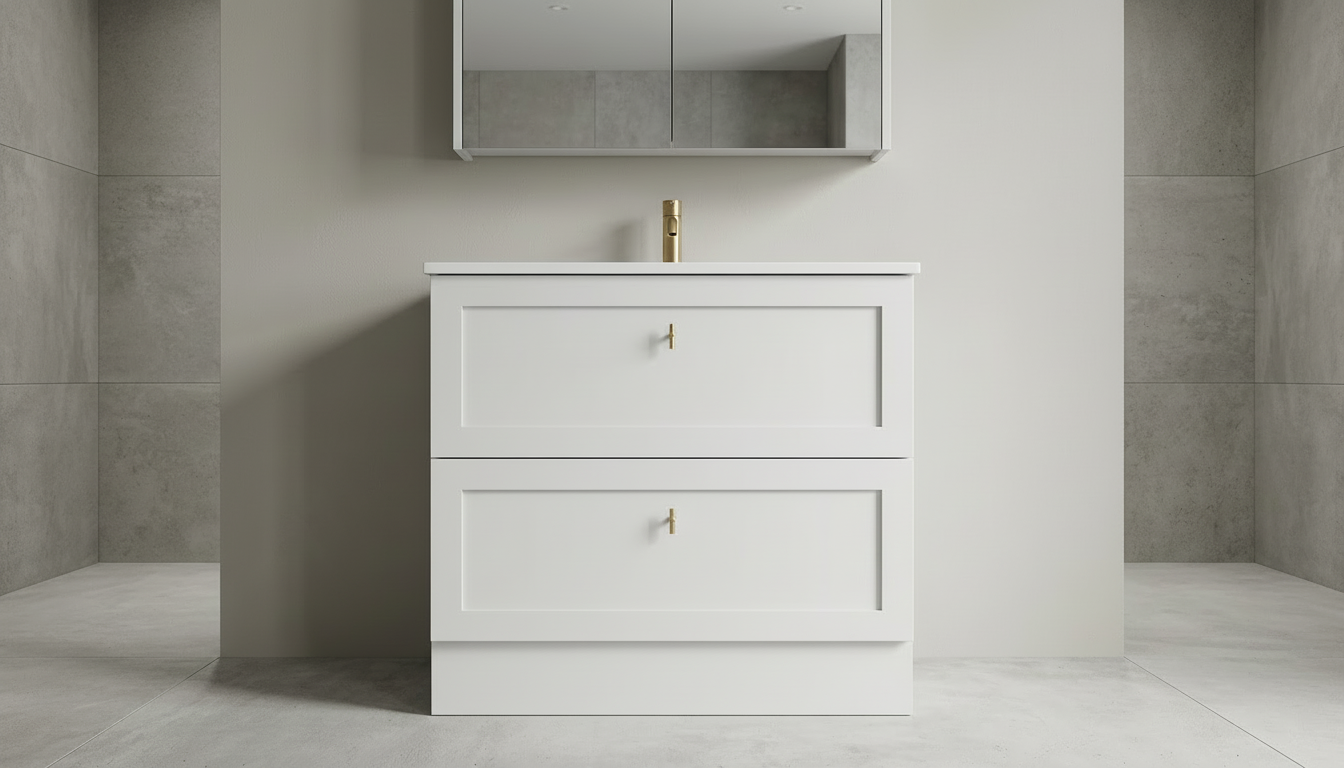
So Which One Actually Suits a Small Bathroom?
As a rule of thumb: if the room is genuinely small — a powder room, an ensuite under about 4m², or anywhere the vanity is within arm’s reach of the shower screen and the door at the same time — wall-hung is almost always the better call, purely for the floor space it gives back. The visual gain is real, and in a small room, every centimetre you can make look bigger is worth having.
Freestanding earns its place when storage matters more than a few centimetres of visual floor space, or when the wall behind the vanity isn’t a realistic fixing point without extra building work. A family bathroom that needs to store four people’s worth of towels, hairdryers and toiletries will get more day-to-day use out of a deep-drawered freestanding unit than it will out of the slightly larger-looking floor.
There’s a middle path worth mentioning too: a wall-hung vanity with a tall boy or mirror cabinet alongside it, like pairing the Nimis or Tarnos wall-hung units with the Tarnos Tall Boy. You get the visual and cleaning benefit of the wall-hung format at the basin, and you claw back the storage you’d otherwise lose, in a unit that takes up a much smaller floor footprint than a wide freestanding vanity would.
A Few Practical Things to Check Before You Order
Whichever way you land, there are a few things worth confirming before you commit:
- Wall construction. Get this checked before sheeting starts if you want wall-hung. Retrofitting blocking after the wall’s closed up is possible but adds cost and time you don’t need.
- Rough-in height and spacing. Wall-hung vanities are usually installed a little higher off the floor than freestanding ones, so your tapware and waste rough-in heights need to match the vanity you’ve actually chosen — not a generic measurement.
- Basin type. Most of our wall-hung and freestanding vanities come with either an integrated solid surface top or a vitreous china top and bowl. Solid surface is easier to keep clean day to day since there’s no seam between top and basin; vitreous china tends to be the more budget-friendly option without giving up much durability.
- Door swing and drawer clearance. In a small bathroom, check that a door or towel rail isn’t going to clash with a fully open drawer. It sounds obvious until it’s the thing you discover on install day.
If you’re not sure which width or format will actually fit your room, send us your bathroom dimensions and we’ll help you work out what suits — same as we would with any other package quote. You can also browse the full bathroom vanities range to compare widths, tops and finishes side by side.
Common Questions
Can I fit a wall-hung vanity if my bathroom already has tiled walls?
Yes, but it’s harder than doing it before tiling. You’ll need to locate solid fixing points through the tile, which usually means a stud finder and masonry-rated fixings rather than standard wall plugs. It’s doable on a lot of renovations, but if you’re tiling from scratch, get the blocking in first — it saves a headache later.
Do wall-hung vanities cost more than freestanding?
Not necessarily on the unit itself — plenty of wall-hung ranges, like the Nimis and Tarnos units above, sit in a similar price bracket to a comparable freestanding vanity. Where the cost can creep in is installation, since a wall-hung unit sometimes needs extra bracket work or wall reinforcement that a freestanding unit doesn’t. Worth asking your plumber or builder to quote both ways if you’re on the fence.
Is a freestanding vanity harder to clean than wall-hung?
Not the unit itself — it’s the floor junction that’s the difference. A wall-hung vanity leaves the floor open, so there’s nothing for hair and dust to collect against. A freestanding vanity has a kickboard or legs meeting the floor, which needs the same attention as any other cabinet edge in a wet room. Neither is hard to keep clean, but wall-hung genuinely needs less thought.
What’s the smallest vanity width that still feels usable?
600mm is the practical minimum for a single basin vanity with real drawer storage — anything narrower and you’re usually looking at a slimline basin with little to no bench space. For a powder room, that’s often fine. For a bathroom you’ll actually use every morning, 750mm to 900mm is a more comfortable working width if the room can spare it.
Vanities in our range are collection only from our Brisbane warehouse — the pickup address and collection times are sent with your order confirmation. Stock levels shown on each product page are live.